Experienced CROs know how to build a revenue engine. AWS adds something different: a partner with its own sellers, programs and systems. Its rules differ from both direct sales and a traditional channel. The CROs who get the most from AWS apply what already works for them, then adjust for how AWS operates. That starts with a clear AWS go-to-market strategy. It answers what AWS should contribute to revenue, and by when.
This is Part 1 of Starting Right with AWS, our six-part series for revenue leaders new to the AWS partnership motion. Before listings, integrations or co-sell plays, a CRO has one decision to make: what AWS should do for this business. (For wider context, see AWS Partner 2026: What’s Changing and How to Win.)
Why your AWS go-to-market strategy needs a thesis before a plan
AWS rewards partners who show up consistently. Its co-sell programs have entry requirements that take quarters to meet. Its systems also favor partners with a clear story about where they win. A motion that starts and stops every time priorities shift rarely gets far enough to pay off.
That makes the first conversation strategic. Before your team builds anything, your CEO, board and leadership team need to agree on what AWS should deliver. A written thesis gives everyone the same expectations and gives you something to measure against in six months.
Four questions that shape your AWS go-to-market strategy
1. Is your product built on AWS?
AWS sellers pay closest attention to partners whose products drive AWS usage in their accounts. If your platform runs on AWS, every deal you win can grow the customer’s AWS footprint. That gives an AWS seller a reason to help.
It also matters for how customers can pay. Since May 1, 2025, only Marketplace SaaS products that run fully on AWS count toward a customer’s AWS commitment. If you are partly hosted elsewhere, that is worth knowing before you build your Marketplace pitch around committed spend.
2. Do your target customers buy through AWS?
Look at your top 20 customers and your largest open opportunities. How many run primarily on AWS? How many hold committed AWS spend or prefer to buy software through AWS Marketplace? Your finance and procurement contacts at those accounts can often tell you in one conversation.
If most of them do, Marketplace can shorten procurement and open up budget buyers have already approved. If few do, AWS can still help, mainly through co-sell and reach.
3. Does your ICP overlap with where AWS sellers spend their time?
AWS organizes its sellers around customers, industries and segments. The closer your ICP maps to theirs, the easier it is for an AWS seller to see where you fit. Specificity helps here too. AWS now uses a matching engine to recommend partners to its sellers. It rewards partners who are precise about the workloads and industries they serve. (We explain how that engine works in AWS Is Building the System That Decides Which Partners Sellers See.)
4. Can you commit the people and the time?
You earn your way into AWS’s co-sell programs. The AWS ISV Accelerate Program is a good example. It requires a generally available Marketplace listing and ACE eligibility. You also need at least 15 qualified and five launched ACE opportunities in the past 12 months. And someone on your team must complete AWS’s co-selling training.
None of that is difficult, but all of it takes consistent effort. Someone needs to own the motion, and your sales team needs to take part. Leadership also needs to protect it until it produces results.
What the first year of an AWS go-to-market strategy looks like
Most successful AWS motions build in three phases.
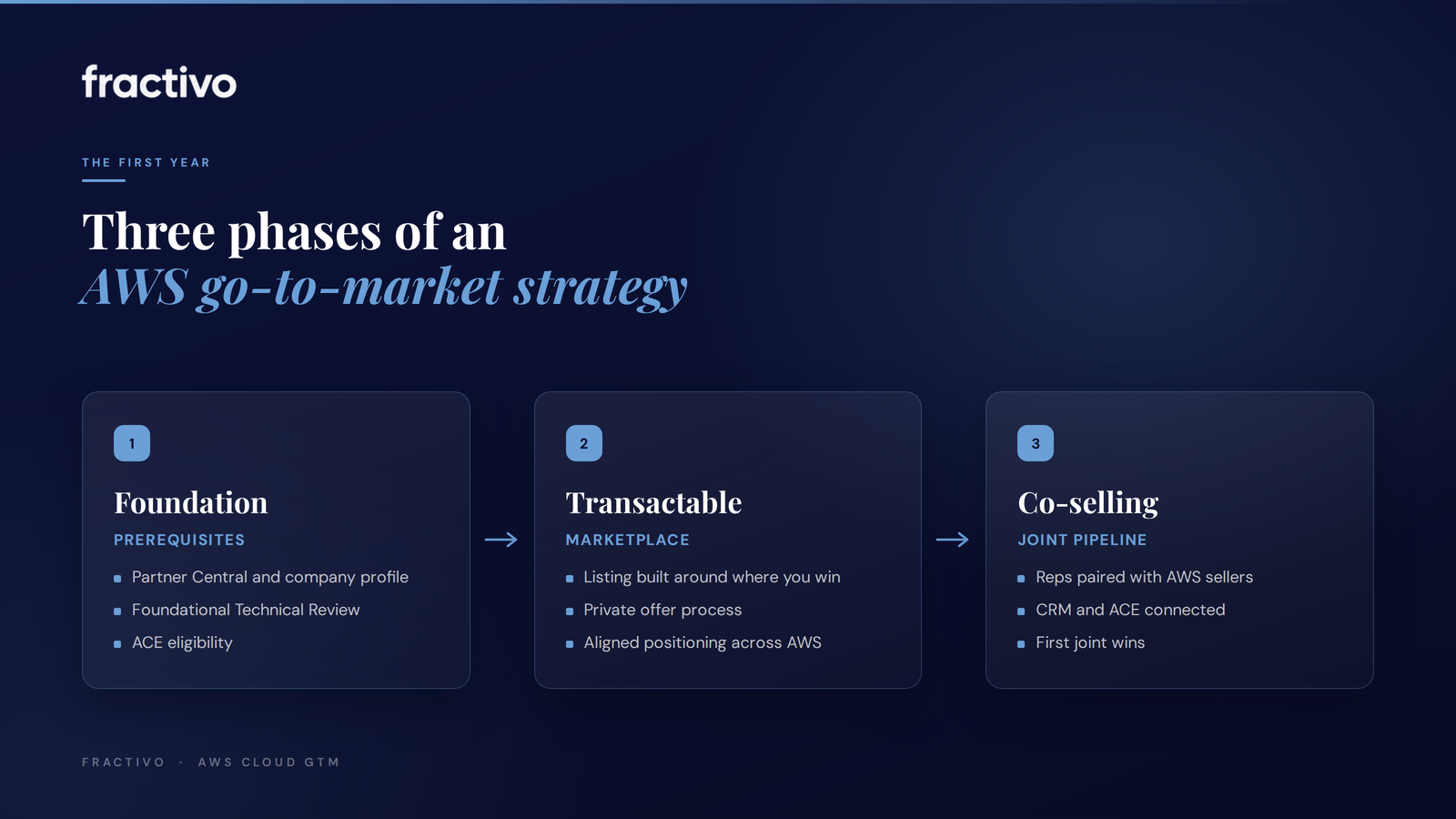
Foundation. Partner Central, the Foundational Technical Review and the requirements for ACE eligibility. This work is unglamorous, and skipping it is what stalls companies later.
Transactable. A Marketplace listing written around the customers and workloads where you win. A private offer process your team can run without friction.
Co-selling. Reps working alongside AWS sellers on named accounts. Opportunities flowing between your CRM and ACE. The first joint wins you can point to.
Each phase depends on the one before it. The CROs who get the most from AWS plan all three phases of their AWS go-to-market strategy from the start. The returns arrive later.
Putting your AWS go-to-market strategy on one page
Your thesis should fit on a single page and answer six questions:
- Contribution: What share of pipeline and bookings should AWS influence or source in 12 months?
- Segments: Which customers, industries and regions will you focus on with AWS?
- Value to AWS: Which AWS services does your product drive, and why should an AWS seller care?
- Investment: Who owns the motion, and what budget and time does it get?
- Milestones: What must be true at three, six and 12 months?
- Evidence: How will you know it is working, and when will you decide to change course?
Share it with your CEO and board early. It turns AWS from a vague opportunity into a plan with owners and dates.
Where AWS motions commonly stall
Listing first, strategy later. AWS tooling makes it easy to launch a listing and connect ACE. It assumes you already know who you are selling to with AWS and why. Most companies skip that step, then rewrite everything six months later.
Handing AWS to a single hire. An alliance manager can run the relationship, but co-sell happens in deals. If your sales team is not involved, AWS introductions stall once they reach a rep.
Measuring only sourced pipeline. Early AWS value often shows up as influenced deals, faster procurement and better access to accounts. Measure only sourced pipeline and the motion can look like a failure before it has time to work.
How Fractivo helps CROs build an AWS go-to-market strategy
Fractivo helps ISV revenue leaders who are new to AWS build their partnership motion the right way from the start. We start with an assessment against our Cloud GTM Maturity Model. It shows where you stand across Marketplace, co-sell, technical readiness and team alignment. From there, we help you write your AWS thesis and turn your AWS go-to-market strategy into a phased plan.
Then we stay involved. We work embedded, week over week, as your fractional alliance team, so the plan turns into pipeline.
New to the AWS partnership motion? Request the CRO’s AWS Readiness Checklist or email us and we’ll send it to you.
Frequently asked questions
What is an AWS go-to-market strategy?
An AWS go-to-market strategy defines how a software company will use AWS to reach, sell to and transact with customers. It covers which customers you will pursue with AWS and how you will co-sell with AWS sellers. It also covers how customers buy through AWS Marketplace and what revenue AWS should contribute.
Should every SaaS company partner with AWS?
No. AWS is most valuable when your product runs on AWS and your customers already buy through AWS. It also helps when your target market overlaps with the accounts AWS sellers cover. Testing those factors first saves time and budget.
Do AWS Marketplace purchases count toward a customer’s AWS commitment?
Since May 1, 2025, only Marketplace SaaS products that run fully on AWS count toward a customer’s AWS commitment. Eligibility also depends on the customer’s own agreement with AWS.
What are the requirements for the AWS ISV Accelerate Program?
According to AWS, you need a generally available Marketplace listing, ACE eligibility and Validated or Differentiated status in Partner Central. You also need at least 15 qualified and five launched ACE opportunities in the past 12 months. A team member must complete the Co-Selling with AWS training. You also need a minimum level of recognized AWS revenue.
How long does it take to start co-selling with AWS?
It depends on your starting point. Foundation work and a Marketplace listing can move quickly. AWS’s co-sell programs require a track record of qualified opportunities, though. Most companies should plan for several quarters before co-sell becomes reliable.
Next in the series, Part 2: laying the foundation so nothing blocks you later.
Sources: AWS, “AWS ISV Accelerate Program“; AWS Marketplace SaaS commitment eligibility change effective May 1, 2025, as summarized by Bytes.