Every CRO weighing whether to co-sell with AWS asks the same question: what will this do for my number? The honest answer is that AWS can add to pipeline, deal size and speed of close, though rarely in the way revenue leaders first expect. AWS does not hand partners a stream of deals. The value tends to come from making it easier for customers to buy from you, and from AWS getting involved in the deals that matter most to both of you.
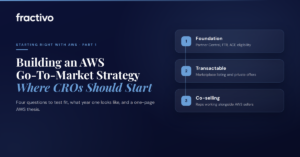
Getting there takes groundwork, and most of it sits outside the sales team. This is Part 2 of Starting Right with AWS, our six-part series for revenue leaders new to working with AWS. Part 1 covered deciding what AWS should contribute to your revenue. This post covers where that contribution realistically comes from, what year one looks like, and what has to be in place before any of it starts.
Where revenue comes from when you co-sell with AWS
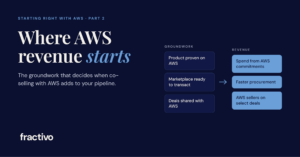
The biggest lever for most software companies is budget. Many large AWS customers have signed multi-year spending commitments with AWS. When they buy eligible software through AWS Marketplace, AWS’s online store for third-party software, part of that purchase can count against the commitment. For the buyer, your product is paid for from money already approved. That can unlock deals stuck in budget review, and it can make larger deals easier to sign.
The rules matter. Since May 1, 2025, only Marketplace software that runs fully on AWS counts toward a customer’s commitment, and each customer’s agreement with AWS sets its own limits. Your reps need to ask about it early in a deal.
The other levers are real, but you control them less:
| Where AWS can help | What has to be in place | How much you control it |
|---|---|---|
| Customers pay from committed AWS spend | A product that runs fully on AWS, sold through AWS Marketplace | Mostly you, within each customer’s agreement with AWS |
| Procurement moves faster for customers who already buy through AWS | A registered Marketplace seller account and a process for custom offers | Mostly you |
| An AWS seller works a deal alongside your rep | The deal shared with AWS, a strong deal record, and a deal AWS considers strategic | Partly. AWS decides |
| AWS refers new deals to you | AWS eligibility to receive referrals, plus a clear fit for the customer and a track record | Least. AWS sellers decide |
Read the table top to bottom as the order to expect results in. The first two rows depend mostly on work you can schedule. The last two depend on AWS, and they build over time.
What year one looks like when you co-sell with AWS
In our experience, the first year you co-sell with AWS has three parts. Your own deals start closing through AWS Marketplace, mostly with customers who already buy through AWS or hold a commitment. A small number of strategic deals get an AWS seller involved. And your company builds the record of shared and closed deals that makes AWS referrals possible later. Plan the year around the first part. Treat the second as a bonus on specific accounts, and the third as an investment in year two.
The cost is mostly people and time:
- An owner for the AWS relationship. Someone has to run it week to week. In smaller companies that is often the CRO at first, or a fractional alliance team.
- Engineering time. A one-off technical review and some setup, covered below. It is modest, but it needs a slot on the roadmap.
- Sales time. Reps and their managers need to share deals with AWS and work with AWS sellers when one is engaged. That habit, more than anything else, decides how much AWS contributes.
- Marketplace fees. AWS takes a fee on Marketplace transactions. We cover pricing and fees in Part 3.
Clear the technical gate early
Before AWS treats your company as a validated software partner, your product has to pass a short technical review, the AWS Foundational Technical Review. AWS rebuilt it recently, and it now returns a result in minutes. The work is in getting ready for it, and three of the steps matter to revenue:
- Proof that your product runs on AWS. This is the same question that decides whether customers can pay you from committed AWS spend. If any part of your product runs elsewhere, find out now. The fix belongs to engineering, and it takes time.
- A Marketplace product record. The review requires your product to be set up in AWS Marketplace, so Marketplace work now starts in this stage.
- Usage tracking switched on. AWS asks you to turn on Partner Revenue Measurement, which shows AWS how much AWS usage your product drives. In our experience, that number is what AWS sellers care about most, because it is what they are measured on.
Passing the review also earns your product a listing in AWS’s partner directory, where AWS teams and customers look for partners, and it is required before AWS will send you referrals.
What to ask for: a named engineering owner and a target date. The details are your CTO’s, and we list them in the FAQ below.
How deals work when you co-sell with AWS
AWS has a system for partners to tell it about their deals, called ACE. Sharing deals there is how you start to co-sell with AWS, and your team can begin the day your company is registered with AWS. Nothing else in this post has to come first.
What AWS does with a shared deal varies. Since June 2026, AWS scores every deal on how complete and specific the record is, then sorts it into one of three tracks (AWS calls them Field-engaged, Agent-engaged and Partner-led):
- AWS seller assigned. An AWS sales team works the deal alongside your rep.
- Needs more detail. AWS’s automated assistant helps your team strengthen the record, and the deal can move up.
- Your team leads. No AWS seller is assigned, and AWS says none should be expected.
The track depends on two things: the quality of your deal record, which your team controls, and how strategically important AWS judges the deal to be, based on the customer, your company and the AWS services involved. AWS states that a better record improves the odds of getting a seller and does not guarantee one. Expect most of your deals to stay with your team, and an AWS seller on the few that matter most to AWS.
Referrals from AWS work the same way. Once your company reaches ACE eligibility, AWS sellers are able to refer deals to you. For software companies, that takes the technical review above, ten deals that AWS has accepted in the past 12 months, a directory listing and agreeing to AWS’s terms. Eligibility makes referrals possible. Whether any arrive depends on AWS sellers seeing you as the right fit for one of their customers, and AWS says they use a matching system that weighs your Marketplace listing, your validated expertise and the history of deals you have shared. Build your plan without them.
What to ask for: every qualifying deal shared with AWS within a week, written so it would hold up in front of an AWS seller. That means the customer’s problem, why they must act now, who decides and a specific ask of AWS. (Our posts on the Opportunity Quality Score show what that looks like.)
Setup that keeps deals from stalling
Three pieces of setup never appear in a forecast, and each can hold up a deal at quarter end.
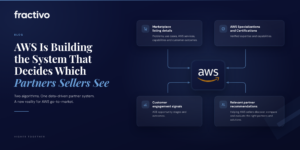
Your company profile with AWS. AWS teams read it when deciding whether you fit an account, so write it in the language you use with customers. (We explained why that consistency matters in AWS Is Building the System That Decides Which Partners Sellers See.)
Your Marketplace seller account. Registration, tax and banking details take time to verify. Finish them early, so a customer who wants to buy through AWS is never waiting on you.
Access for more than one person. When one person holds every login and leaves, deal updates and offers stop until access is sorted out. Give at least two people access to each account.
What to track once you co-sell with AWS
All of this can start in the same week and run side by side. To see whether it is paying off, track AWS the way you track any channel:
- Pipeline where the customer can buy through AWS, in dollars, and how much of it can draw on an AWS commitment.
- Pipeline with an AWS seller engaged, and the win rate and cycle time on those deals compared with the rest.
- Deals closed through AWS Marketplace, by count and value.
- Anything stopping a customer from buying through AWS, such as a hosting question, an unfinished seller account or a missing technical review.
The first three tell you what AWS is doing for revenue today. The fourth tells you what is holding more of it back. Your alliance owner can track the supporting numbers, such as how many deals AWS has accepted toward eligibility.
Where companies that co-sell with AWS stall
Forecasting on AWS-sourced deals. Referrals and AWS sellers are never guaranteed. Plans built around them before they exist end with a gap to explain. Forecast your own pipeline, and add AWS-sourced deals once they show up consistently.
Never asking about the customer’s AWS commitment. If reps do not ask whether a customer has committed AWS spend, the strongest lever in this post goes unused.
A product that runs partly elsewhere. Customers may not be able to pay from committed spend, and the technical review will flag it. Find out early.
Waiting to share deals. Teams that hold back until every technical step is done lose months of track record with AWS.
Engineering hears about it last. The review and setup need engineering time. Without an owner and a date, they lose to product work every sprint.
How Fractivo helps CROs get AWS revenue moving
Fractivo helps ISV revenue leaders co-sell with AWS in a way that shows up in the number. We help you set realistic expectations with your CEO and board, get your Marketplace and AWS accounts ready, coach your team on sharing deals and working with AWS sellers, and keep the technical review on schedule. Your engineering team owns the technical work, and we keep it scoped and tracked to approval.
We start with an assessment against our Cloud GTM Maturity Model, so you can see what is in place and what is holding revenue back. Then we work embedded, week over week, as your fractional alliance team.
Want to know where you stand? Request the CRO’s AWS Readiness Checklist or email us. Section 2 covers every item in this post, with an owner for each.
Frequently asked questions
How soon will we see revenue once we co-sell with AWS?
Usually through your own deals first. Customers who already buy through AWS, or who hold an AWS commitment, can start buying through Marketplace once your listing and seller account are ready and your product runs fully on AWS. AWS sellers join a smaller number of deals, and AWS referrals come later, if at all. Plan around your own pipeline and treat AWS-sourced deals as upside until they appear.
Will AWS send us deals?
Possibly, but it is never guaranteed. Once your company reaches ACE eligibility, AWS sellers can refer deals to you. Whether they do depends on your fit for a specific customer, your Marketplace listing, your AWS Specializations and certifications, and the history of deals you have shared with AWS.
What is the AWS Foundational Technical Review?
The AWS Foundational Technical Review is AWS’s validation of a partner’s software solution against a subset of Well-Architected best practices. An approved FTR earns a Qualified Software badge, a Partner Solutions Finder listing and Validated status on the Software Path.
What does the technical review require?
Before you can request it, AWS checks in order that your solution in AWS Partner Central is linked to exactly one software product in AWS Marketplace, that the product has an approved AWS-hosted architecture shown in an uploaded diagram, and that Partner Revenue Measurement is enabled. AWS notes that measurement data can take up to seven days to appear. You then submit a SOC 2 Type II report or a Well-Architected Framework Review report. An approved review moves your company to Validated status on AWS’s Software Path.
How long does the AWS Foundational Technical Review take?
AWS reviews submissions automatically and returns results within minutes. The preparation takes longer: linking a Marketplace product, documenting your AWS-hosted architecture, enabling Partner Revenue Measurement and having a qualifying SOC 2 Type II or WAFR report ready.
Do I need a SOC 2 report to pass the FTR?
No. AWS accepts either a SOC 2 Type II report or a Well-Architected Framework Review report. The WAFR must be under a year old, show no high-risk issues in the Security, Operational Excellence and Reliability pillars, and be run in the AWS Well-Architected Tool.
How long is an FTR valid?
According to AWS, an approved FTR is valid for two years from approval. Partner Central shows the expiration date on your solution’s Validation tab.
What does ACE eligibility require?
For Validated Software Path partners, AWS’s ACE program FAQ lists ten AWS-validated opportunities in a rolling 12 months, an active Partner Solutions Finder listing and accepted ACE Terms and Conditions.
Can I share opportunities in ACE before I am ACE eligible?
Yes. AWS lets every partner submit opportunities in ACE, and For Visibility Only opportunities count toward eligibility. We recommend starting as soon as Partner Central is set up.
Next in the series, Part 3: getting transactable with an AWS Marketplace listing built around where you win.
Sources:
- AWS Partner Central Sales Guide, Agentic co-sell engagement
- AWS Partner Network Blog, Solution Matching Engine: Your Gateway to AWS Sellers
- AWS, AWS Foundational Technical Review (page updated October 15, 2026)
- AWS Partner Central Builder Guide, Request Foundational Technical Review for your solutions
- AWS Partner Central, ACE Program Frequently Asked Questions (updated July 20, 2026, Partner Central sign-in required)
- AWS, AWS ISV Accelerate Program
- AWS Marketplace commitment eligibility change effective May 1, 2025, as summarized by Bytes