On August 31, AWS published new guidance on the AWS Solution Matching Engine, the machine learning system introduced in 2025 to help AWS sellers identify relevant partners and Marketplace listings for customer opportunities.
The post is a practical guide for partners trying to improve their visibility with AWS sellers. AWS tells partners to keep their ACE data current, make their expertise easy to verify, and improve the quality and consistency of their Marketplace listings.
We think there is a bigger story underneath it.
For years, AWS partners have spent an enormous amount of energy trying to build relationships with sellers so those sellers understand what they do, remember where they fit, and bring them into the right customer opportunities. That still matters. But AWS is increasingly building systems that can do some of that matching before the seller ever calls the partner.
The question is slowly shifting from “Does the AWS seller know who we are?” to “Does AWS understand when to recommend us?”
That is a meaningful change in how partners should think about Marketplace, ACE, Specializations, and their overall cloud go-to-market motion.
How the AWS Solution Matching Engine works
The Solution Matching Engine is designed to help AWS sellers identify partners and listings that are relevant to a particular account or customer opportunity. AWS says sellers use it during account planning and co-sell motions to discover, compare, and evaluate potential partners and solutions.
To do that, the system brings together several types of information that most partners have historically managed separately.
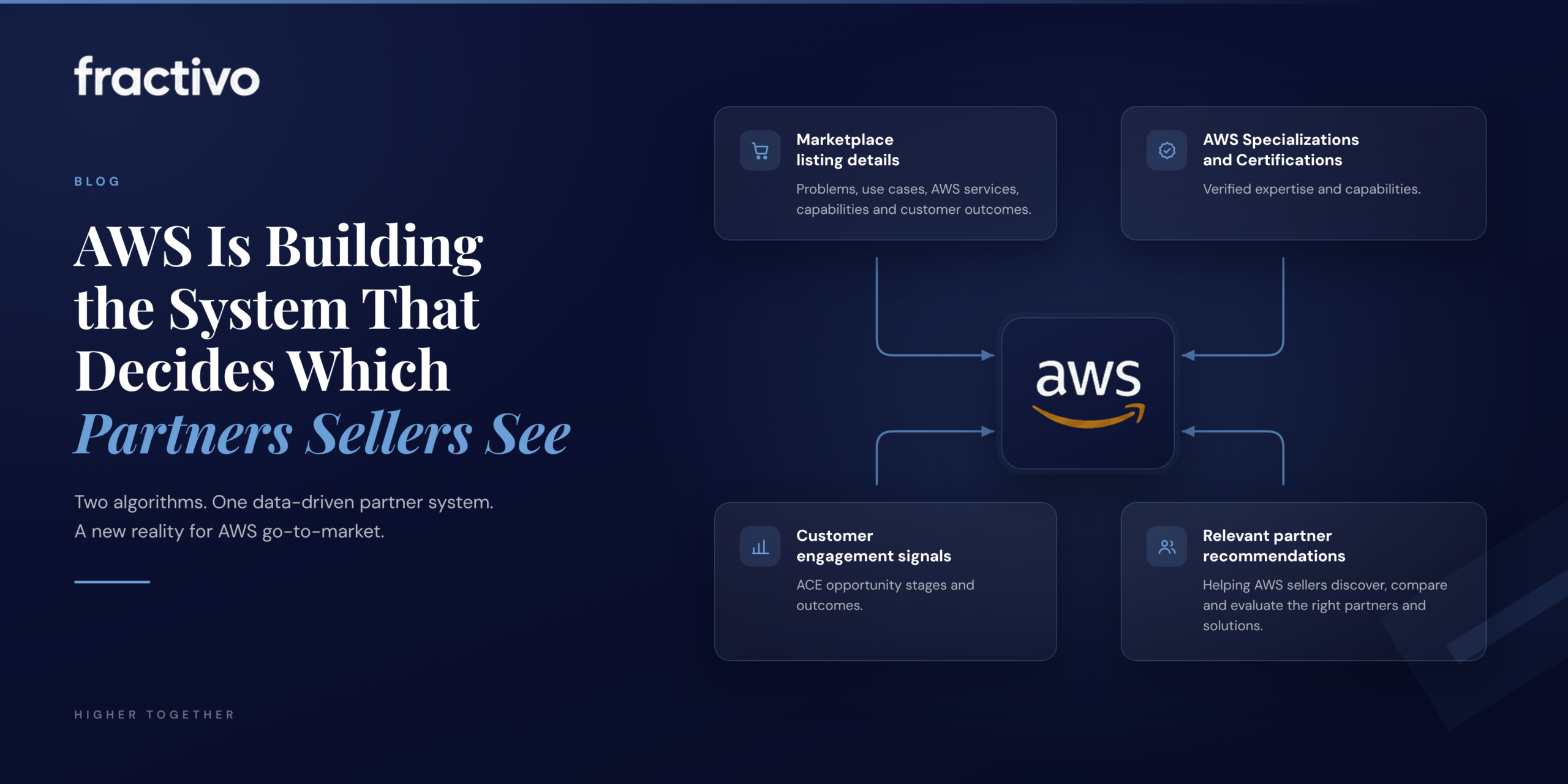
It looks at the problems and use cases described in your AWS Marketplace listings and the AWS services your solution integrates with. It considers verified capabilities such as AWS Specializations and Certifications. It also uses customer engagement signals, including ACE opportunity stages and outcomes.
That last part is particularly important.
Your Marketplace listing tells AWS what you say you do. Your Specializations help establish where AWS has validated your expertise. Your ACE history provides evidence of where you are actually engaging with customers and what happens to those opportunities.
AWS can now bring those signals together to help a seller understand where you might fit.
We would not interpret this to mean AWS sellers are suddenly taking orders from an algorithm. Relationships, seller judgment, account knowledge, and partner reputation still matter. But it does mean the data AWS has about your company can influence whether you are surfaced to the seller in the first place.
That is the part partners should pay attention to.
Two algorithms. One data-driven partner system. A new reality for AWS go-to-market.
AWS is now evaluating both sides of co-sell
This gets more interesting when you put the Solution Matching Engine beside the Opportunity Quality Score AWS rolled out earlier this year.
We wrote about the Opportunity Quality Score in June and then spent the following month working a real client opportunity from roughly 50 toward 75. What became clear through that process was that AWS is making individual co-sell opportunities increasingly measurable and machine-readable.
The Opportunity Quality Score looks at an individual opportunity and helps determine how AWS engages with it. A stronger, better-developed opportunity has a better chance of earning direct field engagement because the AWS seller has more confidence that the deal is real and worth their time.
The Solution Matching Engine approaches the problem from the other direction.
The Opportunity Quality Score effectively asks: Is this deal worth AWS seller attention?
The Solution Matching Engine helps answer: Which partners and solutions might make sense for this customer?
Put the two together and you start to see the system AWS is building.
On one side, AWS is getting better at determining which opportunities deserve seller attention. On the other, it is getting better at identifying which partners should be considered for those opportunities.
For anyone running an AWS partnership, that should change how you think about the data you put into the ecosystem.
The view from the AWS seller’s chair
Before starting Fractivo, our founder spent close to six years inside AWS, including time on the ISV team and in the startup segment. So our instinct with announcements like this is always to look at them from the AWS seller’s perspective.
An AWS seller has a finite amount of time and an almost unlimited number of potential partners they could bring into an account.
They cannot know every software company in Marketplace. They cannot remember every partner they met at re. They cannot call every PDM whenever a customer raises a new requirement. And they definitely do not have time to read through hundreds of partner profiles trying to figure out which company might be the best fit.
That creates a discovery problem.
Imagine a customer tells an AWS seller they need to reduce cloud costs across a large Kubernetes environment. Another needs to modernize a contact center. Another wants a secure generative AI solution for financial services.
The seller needs relevant options quickly.
The Solution Matching Engine is AWS’s attempt to make that matching process more efficient. The better AWS understands what a partner does, where it has demonstrated expertise, and what kinds of customer engagements it has successfully delivered, the easier it becomes to put that partner in front of the right seller at the right time.
Seller attention has always been one of the scarcest resources in the AWS ecosystem. This system is designed to help AWS allocate that attention more efficiently.
For partners, that creates both an opportunity and a risk.
Your Marketplace listing is becoming GTM data
We still see software companies treat AWS Marketplace primarily as a procurement project.
Get the listing live. Get the pricing right. Enable Private Offers. Put a product description on the page. Then move on to the next program.
We think that view is increasingly outdated.
AWS specifically says the Solution Matching Engine uses listing details such as the customer problems you address, use cases, AWS services integrated, capabilities, customer outcomes, and differentiators. That information helps sellers understand not only what you sell, but when your offering may be relevant.
In other words, your Marketplace listing is no longer just something a customer reads at the end of a sales process. It is becoming part of the information AWS uses upstream to understand your business.
That means the listing needs to do two jobs.
It needs to make sense to a human being. An AWS seller should be able to look at it and quickly understand the problem you solve, who you solve it for, and why a customer should care.
But it also needs to give AWS’s systems clear and consistent information about the use cases, workloads, outcomes, and AWS services associated with your solution.
That is a much higher bar than simply having a good product description.
The consistency problem most partners probably have
One of the more interesting recommendations in AWS’s post is to use consistent language across AWS Marketplace listings, the Partner Central profile, and ACE opportunity records.
That sounds like basic content hygiene. We think it is more important than that.
Look at how these assets are usually created inside a software company. Marketing writes the Marketplace listing. Alliances manages Partner Central. Sales enters the ACE opportunities. A technical team handles Competencies and Specializations. Corporate marketing owns the website.
None of those teams are necessarily using the same language.
The Marketplace listing may describe the company as an AI infrastructure platform. The Partner Central profile may emphasize application modernization. The salesperson registering an ACE opportunity may describe a cost optimization use case. The website may lead with DevOps automation.
All four descriptions could be accurate. A human who understands the company can connect them.
AWS’s systems should not have to guess.
If AWS is using all of these signals to understand where your company fits, consistency becomes an operating advantage. The clearer you are about the problems you solve, the workloads you support, the customers you serve, and the outcomes you produce, the easier it becomes for AWS to build a coherent picture of your business.
This is why cloud GTM messaging is becoming more than a marketing exercise. It is becoming part of your partner infrastructure.
ACE is becoming part of your reputation with AWS
The other signal we would pay close attention to is customer engagement history.
AWS says the Solution Matching Engine considers opportunity stages and outcomes. It also explicitly tells partners to keep ACE information complete and current, including customer context, use cases, opportunity stages, next steps, revenue information, associated AWS Marketplace listings, AWS services, and launched or closed outcomes.
This reinforces something we have been saying since AWS introduced the Opportunity Quality Score: ACE is no longer just administrative plumbing.
The information you put into ACE increasingly helps AWS understand the quality of an individual opportunity and the broader context of where your company engages successfully.
Consider two partners making essentially the same claim.
Both say they are strong at migrating enterprise workloads to AWS. Both have capable sales teams and credible technology.
One has a clear Marketplace listing, relevant AWS Specializations, consistently maintained ACE opportunities, the appropriate solutions attached to those opportunities, and a documented history of customer outcomes.
The other has a generic listing, stale ACE records, inconsistent positioning, and limited evidence inside AWS’s systems of where it actually wins.
An experienced seller who knows both partners may already know which one they trust.
The difference now is that AWS is building systems capable of seeing more of those signals at scale.
That is potentially very powerful.
The partner-data flywheel
The partners that get this right could create a compounding advantage.
Clear Marketplace positioning helps AWS better understand where the solution fits. Better matching can increase the likelihood of being surfaced in relevant seller conversations. More relevant seller conversations can create better co-sell opportunities. Those opportunities create richer ACE data and, ideally, more launched customer outcomes. Those outcomes then give AWS more evidence about where the partner is successful.
That evidence can make future recommendations better.
There is a flywheel here:
Better positioning → better matching → more relevant opportunities → stronger customer outcomes → better data → better future matching.
We do not know the weighting AWS gives each signal inside the Solution Matching Engine, and partners should be skeptical of anyone claiming they have reverse-engineered the algorithm.
That is not the point.
You do not need to game the system. You need to make it easy for the system to understand what is already true about your business.
What we would do about it
If we were reviewing an AWS partner’s GTM motion this quarter, the first thing we would do is put its Marketplace listings, Partner Central profile, ACE records, Specializations, and website messaging beside each other and ask a very basic question: Does AWS see the same company everywhere?
For a surprising number of partners, the answer will be no.
We would then tighten the Marketplace positioning around the customer problem, use case, business outcome, workload, and relevant AWS services rather than leading with product architecture or generic marketing language. The goal is to make it immediately obvious when the solution belongs in a customer conversation.
Next, we would look closely at ACE. Opportunity data should be current. The appropriate AWS services and Marketplace listings should be associated with the deal. Next steps should reflect what is actually happening with the customer. Stages should move when the deal moves, and launched outcomes should get recorded.
Finally, we would decide what we actually want AWS to associate the company with. Most partners cannot be the answer to every customer problem. Choose the workloads, use cases, customer types, industries, and business outcomes where you have a legitimate right to win, then make sure those signals appear consistently throughout your AWS presence.
None of this is particularly complicated.
The important change is that it is no longer just good partner marketing. AWS is giving partners a clearer indication that this information feeds the systems sellers use to find and evaluate them.
Our take
We think AWS is moving toward a partner ecosystem where relationships still matter, but data increasingly determines where those relationships get applied.
That distinction matters.
A great alliance leader will still build strong AWS relationships. A good PDM will still advocate for partners. AWS sellers will still use their own judgment about which companies they trust and which solutions make sense for a customer.
But AWS is putting an intelligence layer underneath that human network.
The Opportunity Quality Score helps make individual deals easier to evaluate. The Solution Matching Engine makes partners and solutions easier to discover. Marketplace listings can now be associated directly with co-sell opportunities in Partner Central. Specializations provide verified signals of expertise. ACE records capture customer engagement and outcomes.
These are not isolated product updates. They increasingly look like parts of the same system.
For years, a lot of cloud GTM strategy was built around getting known by AWS. Get meetings with the right sellers. Build relationships with the right teams. Get invited into the right accounts.
All of that still matters.
But the next competitive advantage may be making sure AWS actually understands you before the meeting ever happens.
That means your Marketplace presence, ACE pipeline, Specializations, customer outcomes, and positioning need to tell the same story.
Because increasingly, AWS is reading that story too.
Source: AWS Partner Network, “Solution Matching Engine: Your Gateway to AWS Sellers,” August 31, 2026.