An AWS Competency tells an enterprise buyer that AWS has reviewed a partner’s technical depth and real customer results in a specific area. It doesn’t close deals on its own. However, missing one can slow a deal down, especially once security, architecture or procurement teams get involved.
This guide covers what an AWS Competency is in 2026, what it signals to buyers, and what AWS changed this year. It also covers the new Amazon Connect Customer Competency and how to prepare an application that passes.
What an AWS Competency is
AWS Competencies are part of the AWS Specialization program. According to AWS, the program “validates AWS Partners who demonstrate technical excellence across industries, use cases, and services.” To earn one, a partner passes technical assessments, including “reviews of multiple customer success examples.”
AWS currently lists three kinds of specialization:
- AWS Competency. This validates partners who use AWS to solve industry and use-case challenges. Examples include Consumer Goods, SMB, Cyber Insurance and Oracle.
- AWS Managed Services Provider (MSP). This covers partners that provide end-to-end AWS solutions and services.
- Service Delivery and Service Ready. AWS is deprecating both. New applications are closed, and the deprecation date is June 1, 2027.
That last point matters if your roadmap still includes Service Ready. For most software companies, the AWS Competency is now the specialization to plan around.
What an AWS Competency signals to buyers
In real buying motions, a competency reduces the risk a buyer has to carry. Mid-market and enterprise buyers rarely ask about it directly. Instead, it answers three questions they’re already asking:
- Has AWS seen this product work for real customers?
- Will this create friction with our cloud or security teams?
- If something breaks, are we in an unsupported edge case?
A competency doesn’t guarantee approval. Even so, without one, deals often see more scrutiny, longer reviews and extra requests for proof. This shows up most in deals that involve AWS Marketplace, security sign-off or a co-sell conversation with AWS.
Most buyers don’t separate competency types
In practice, buyers usually see “AWS validated” and read it as credibility. The difference between specialization types matters more inside your company and inside AWS than it does to the buyer.
The value shows up late in the deal
Generally, competencies rarely create inbound demand. Instead, they tend to unblock deals that have stalled in review. As a result, a team that measures a competency only by lead volume will usually feel underwhelmed.
There’s a lag between earning it and seeing impact
Naturally, it takes time for your sellers, your partners and AWS account teams to absorb that your product is now validated. Plan for that lag, and start using the competency in deals as soon as it’s approved.
What an AWS Competency gets you
AWS lists the benefits of its specializations in three groups on its Specialization page:
- Recognition. Partner badges, priority placement in the AWS Partner Solutions Finder, an improved co-sell score and direct access to AWS Sales teams.
- Funding. Marketing Development Funds, Migration Acceleration Program funding for eligible workloads, and discounts.
- Access to AWS experts. AWS PartnerEquip, GTM Acceleration Workshops, partner-led webinars and the APN Customer Engagements (ACE) program.
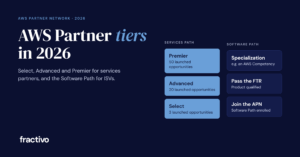
These benefits help, but AWS still decides which deals its sellers engage on. A competency improves how AWS sees you. It doesn’t commit AWS to co-sell any particular opportunity. For how tiers, paths and specializations fit together, see our guide to AWS Partner tiers in 2026.
What changed for the AWS Competency program in 2026
Three changes this year affect how you prepare.
Program Navigator and a faster specialization review
On October 20, 2026, AWS launched Program Navigator in Partner Central. AWS calls it “a unified experience that lets partners discover, apply for, and track AWS Specialization program applications.” AWS also says partners should see “faster review times and more detailed, requirement-level feedback.”
In addition, go-to-market case studies now follow a lighter path. As a result, partners can publish them to AWS domains after a lightweight policy check. The deeper review applies only to case studies tied to a Program Navigator application.
The FTR moved to SOC 2 or Well-Architected reports
Software companies qualify their product through the Foundational Technical Review (FTR). Since June 16, 2026, Partner Central accepts a SOC 2 Type II report or an AWS Well-Architected Framework Review report to complete it. Consequently, AWS says partners get approval or actionable feedback within minutes. If a control fails, partners also get specific remediation steps.
The first competency tied to an AWS service
On June 16, 2026, AWS launched the Amazon Connect Customer Competency. The next section covers it in detail.
The Amazon Connect Customer Competency: a new AWS Competency
AWS describes the Amazon Connect Customer Competency as “the first AWS Competency directly aligned to an AWS service” in its launch post. It validates services partners with proven depth on Amazon Connect Customer. To apply, a partner must first be a validated or differentiated member of the Services Path.
Two categories
- Contact Center Transformation. Moving legacy on-premises or cloud contact centers to Amazon Connect Customer.
- AI-Powered Customer Experience. Building AI agents, conversational AI, agent assist and multi-channel self-service.
Benefits and the deadline to know
Partners who earn it get $50K in Marketing Development Funds in both 2026 and 2027. They also get Migration Acceleration Program funding to offset customer migration costs, plus the PartnerEquip live Amazon Connect track. On top of that, AWS lists co-selling support, private strategy sessions and AWS guest speakers at partner-led events.
However, note one deadline. This competency replaces the Amazon Connect Service Delivery designation, which AWS deprecates on June 1, 2027. If you hold that designation today, plan the move now.
Proof that the business case works
AWS points to Pronetx and New York Cancer & Blood Specialists. Together, they built an AI-powered contact center on Amazon Connect Customer. As a result, the practice stopped handling more than 30,000 calls a month by hand, and patient enrollments rose 54% within eight weeks. The 13 launch partners include Accenture, Caylent, Deloitte, Genpact, Infosys, NeuraFlash, NTT DATA, PwC, Pronetx, Salesforce, TTEC Digital, USAN and Zendesk.
Our read for Connect partners
AWS chose a customer experience service for its first service-aligned competency, which shows where it expects partners to invest. If you’re weighing it, lead with migration, since the Contact Center Transformation category gives you the opening. Then prove the improvement before you expand into AI agents and agent assist. Finally, build observability and testing into every proposal. Enterprises will not put AI in front of their customers without that.
Where teams get stuck on an AWS Competency
Across the software companies we work with, the same patterns repeat.
They start too late
Too often, teams pursue a competency only after deals turn enterprise-sized. By then, procurement and security teams are already asking for proof the company can’t yet show.
Sellers can’t explain it
The competency exists, but sellers can’t say what it means in buyer terms. Consequently, it never comes up in deal conversations.
It lives on the website instead of in the deal
Typically, the badge goes on the homepage. However, nobody maps it to the pipeline stages where it actually helps, such as security review, architecture approval and Marketplace procurement.
None of these problems is fatal. Still, they explain why so many companies feel underwhelmed after earning validation.
How to prepare an AWS Competency application
A competency works best when you treat it as part of deal readiness. Before you apply, make sure it will reinforce three things:
- Why your product is safe to standardize on AWS.
- Why security and platform teams don’t need to redo the validation.
- Why AWS sellers are comfortable attaching your product to their accounts.
Next, plan the customer case studies early. After all, they’re where many first drafts get sent back, so they deserve the most time. Then get your technical baseline ready for review, including the FTR for software companies.
Fractivo helps AWS partners through each stage:
- Assess readiness. First, we run a gap analysis against the requirements, so you know what’s missing before you apply.
- Build the evidence. Next, we package the case studies, architecture and references the validation asks for.
- Prepare for validation. Then we get your baseline ready for review, so you can pass the first time.
- Turn the badge into pipeline. Finally, we put the funding and co-sell benefits to work in live deals.
For example, Docebo completed two AWS Competency submissions in 12 weeks with Fractivo’s support. AWS approved its Education Competency within three days of submission, and its Nonprofit Competency followed in May 2026. Read the full Docebo case study.
FAQ
What is an AWS Competency?
An AWS Competency is an AWS Specialization. It validates partners that show technical depth and proven customer success in a specific industry or use case. To earn one, partners pass technical assessments that include reviews of multiple customer success examples.
Is AWS Service Ready still available?
No. AWS says Service Delivery and Service Ready are being deprecated, and new applications are closed. The deprecation date is June 1, 2027.
Does an AWS Competency guarantee co-selling with AWS?
No. AWS lists an improved co-sell score and access to AWS Sales teams among the benefits. However, AWS still decides which opportunities its sellers engage on.
What is the Amazon Connect Customer Competency?
It’s the first AWS Competency directly aligned to an AWS service, launched on June 16, 2026. It covers two categories: Contact Center Transformation and AI-Powered Customer Experience. It also replaces the Amazon Connect Service Delivery designation, which AWS deprecates on June 1, 2027.
Work with Fractivo
If an AWS Competency is on your roadmap, or a deal is stalling for lack of one, talk to us. We’ll show you where you stand against the requirements and what to fix first.
Sources
- AWS Specializations, AWS, updated October 26, 2026
- From legacy to AI-powered: Transform your customer experience with Amazon Connect Customer Competency Partners, AWS Partner Network blog, June 16, 2026
- AWS Partner Central launches Program Navigator, Case Study Generator, and streamlined specialization review, AWS, October 20, 2026
- AWS Partner Central validates the Foundational Technical Review in minutes, AWS, June 16, 2026
- Docebo earns AWS Nonprofit Competency, Fractivo, May 12, 2026