In Part 2, we called committed AWS spend the biggest revenue lever most software companies have with AWS. That lever only works once you sell on AWS Marketplace, so a customer can buy from you through AWS. Getting there is what AWS calls being transactable: a customer can accept your offer in their AWS account, AWS bills them, and the money reaches you.
This is Part 3 of Starting Right with AWS, our six-part series for revenue leaders new to working with AWS. Most of the work in this stage is commercial. Pricing, contract terms, payment terms and who runs the offer process are decisions for the CRO, finance and legal, so this is the stage where a revenue leader has the most control. This post covers why it matters to your number, how to build a listing around where you win, what the fees cost, how deals close and what to track in year one.
Why being able to sell on AWS Marketplace matters to revenue
When you sell on AWS Marketplace, three things change for the customers who already buy through AWS.
They can pay from budget already approved. Eligible Marketplace purchases can count against a customer’s AWS spending commitment. Since May 1, 2025, that applies only to software that runs fully on AWS, and each customer’s agreement with AWS sets its own limits. Where it applies, your deal stops competing for new budget.
Procurement has less to do. The customer buys through a vendor they already pay, often on a standard contract their legal team has seen before, and the charge lands on their AWS bill. That can take weeks out of a deal stuck in vendor onboarding.
Billing and collections move to AWS. AWS invoices the customer, collects payment and pays you out on a daily or monthly schedule you choose. You can also set the customer’s payment terms on an offer, anywhere from 15 to 120 days, for customers who pay AWS by invoice.
None of this helps with customers who do not buy through AWS. For them, your normal paper is still the faster path. Treat Marketplace as a way for the right customers to pay you, and keep both options open.
Build the listing around where you win
Your Marketplace listing has three readers. Customers compare you with alternatives. AWS sellers check whether you fit an account. And AWS’s matching system reads it when recommending partners to those sellers. All three respond to the same thing: a clear statement of the customers, industries and problems where you win most often.
In our experience, the strongest listings borrow from the best-performing pages of your own website and your win/loss notes. Name the workloads you handle, the industries you know and the outcomes customers buy you for. A listing that tries to cover everyone gives AWS’s system little to match on. (We covered how that matching works in AWS Is Building the System That Decides Which Partners Sellers See.)
Three commercial choices shape the listing:
- The pricing model. AWS supports annual or multi-year contracts, pure usage billing, and contracts with usage on top. Pick the one closest to how you already sell, so reps quote the same way on and off Marketplace. AWS’s newer automated offer tools work only with contract-based listings, which is worth knowing before you choose.
- The public price. Most enterprise deals close on custom offers, covered below. The public price still anchors every negotiation, so set it as deliberately as your list price.
- Request buttons. Once your company is eligible to receive AWS referrals, you can turn on buttons that let a customer ask for a demo or a custom offer from the listing. Requests reach you as opportunities in Partner Central. They are leads to work, with no promise of volume.
What to ask for: a generally available listing reviewed by your best rep and your product marketer, with the same positioning as your website and your AWS partner profile. Add a pricing model your deal desk can quote without a workaround, and a quarterly review so the listing keeps pace with the deals you win. A generally available listing is also a requirement for AWS’s ISV Accelerate co-sell program.
What it costs to sell on AWS Marketplace
AWS charges nothing to list. It takes a fee only when a deal transacts, deducted from what it pays you and calculated on the pre-tax contract value. For software sold as a hosted service, AWS’s current rates are:
| How the deal closes | AWS listing fee |
|---|---|
| Software at public listing price | 3% |
| Software on a custom (private) offer under $1M total contract value | 3% |
| Software on a custom offer from $1M to under $10M | 2% |
| Software on a custom offer of $10M or more | 1.5% |
| Renewal of an earlier software agreement, any size | 1.5% |
| Professional services on a custom offer | 0.5% |
| Professional services bundled with paid software in a qualifying offer set | 0% |
| Any offer through a reseller (channel partner private offer) | the rate above plus 0.5% |
Two details move the number. The 1.5% renewal rate applies only when the new offer is linked to the agreement it renews, including a contract you signed outside Marketplace. And the reseller uplift is charged on the discounted price you give the reseller. Buyers in some regions add a further fee, such as 1% for South Korea.
Selling services alongside your software
If your team sells implementation, onboarding, training or managed services, those can go through Marketplace too. Professional services sell only on custom offers, and the fee is 0.5%, down from 2.5% before June 2026. For many companies, that makes Marketplace one of the cheapest ways to bill services.
Offer sets go a step further. An offer set groups several custom offers into one package the customer accepts in a single step, so your software and your services, or another partner’s services you are authorized to resell, arrive as one purchase. After signing, the customer can manage the term and renewal of each piece separately. AWS also lets sellers publish a solution page that shows how the pieces work together.
Bundling changes the fee. When your services are sold in an offer set where every offer has been accepted and at least one paid product is software, the services fee drops to 0%. The reseller and regional uplifts still apply, and the 0% rate covers only agreements created after AWS launched it.
For a CRO, the revenue case is simpler procurement. A deal that needs software plus a services statement of work usually means two approvals and two vendor reviews. An offer set turns that into one. Whether services can draw on a customer’s AWS commitment depends on their agreement with AWS, so confirm it with the customer before counting on it.
The better question for a CRO is what the fee replaces. Compare it with the cost of a slow procurement cycle, of chasing invoices, and of the discount a rep offers to get a deal past budget review. In our experience, when Marketplace shortens a cycle or unlocks committed spend, the fee pays for itself on that deal. When it does neither, selling direct may be the better path for that customer.
What to ask for: a written rule on who absorbs the fee and whether Marketplace pricing matches your direct pricing. Decide it once, with finance, so it does not get renegotiated deal by deal.
How deals close when you sell on AWS Marketplace
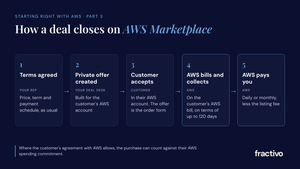
Most negotiated deals on Marketplace close through a private offer: a custom price and set of terms built for one customer. The rep agrees terms as usual. Someone on your team creates the offer for the customer’s AWS account, the customer accepts it in AWS, and AWS bills them. The offer is the order form.
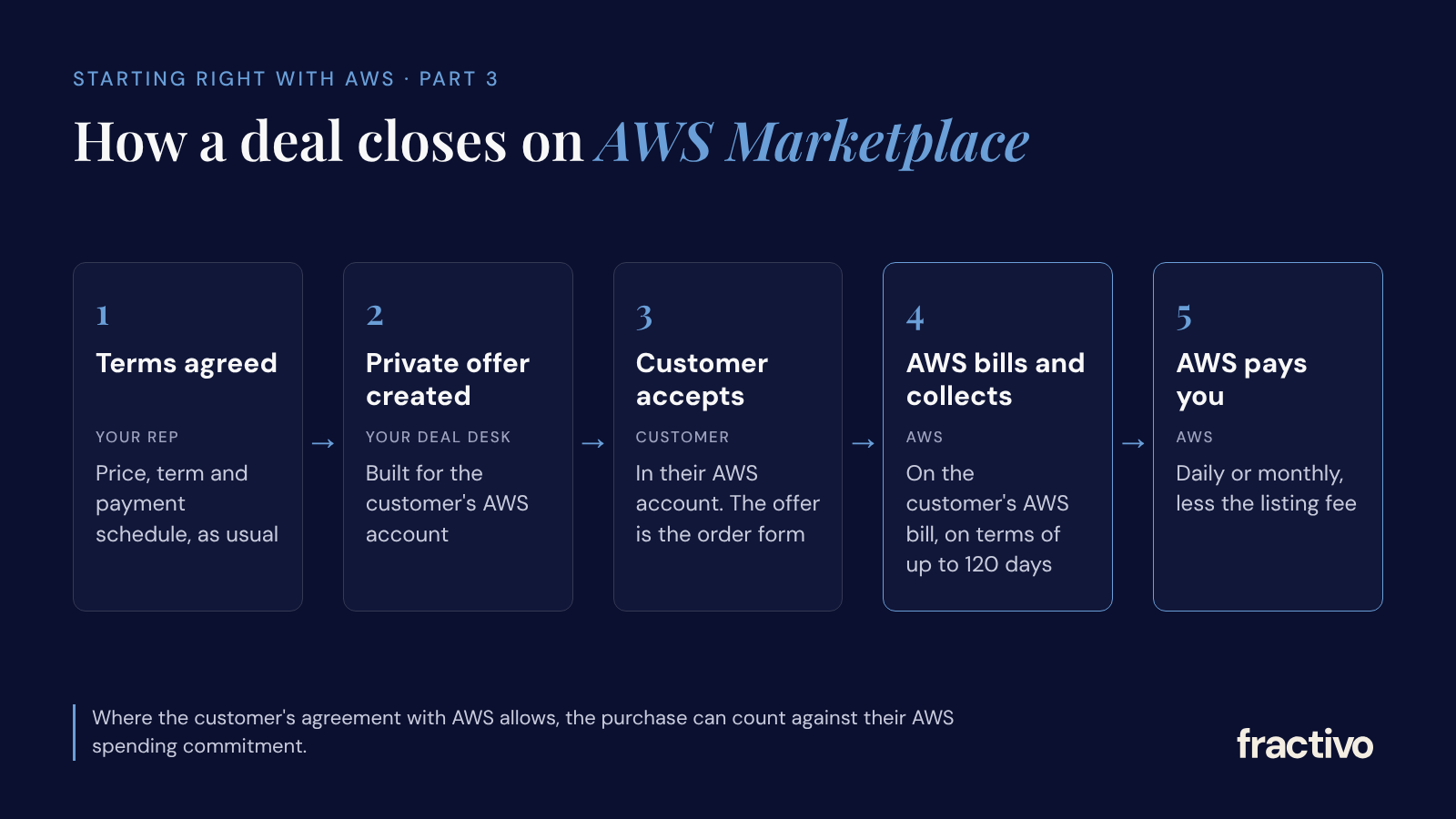
What surprises most revenue leaders is how much of a normal contract a private offer can carry:
- Payment schedules. Annual payments on a multi-year deal, or custom instalments, set inside the offer.
- Payment terms. Anywhere from Net 15 to Net 120, for customers who pay AWS by invoice.
- Contract terms. Your own terms, or AWS’s standard Marketplace contract, which many customers’ legal teams have already reviewed.
- Renewals. Since September 2026, direct contract offers can renew automatically on terms agreed up front, with either side able to opt out before the deadline.
Two variations matter as you grow. Resellers can sell your product through Marketplace with a channel partner private offer. You set the price to the reseller, the reseller sets the customer’s price, and AWS pays each of you. Express private offers let customers get an offer from your listing within minutes, based on pricing rules you set in advance. Since June 2026, AWS sellers can send those offer links to customers on deals they share with you. AWS says enabling them may help how its systems rank you for its sellers. It is a signal in your favor, with no promise of deals.
The point where most teams slip is ownership. Offers created late, with the wrong account number or the wrong price, cost deals at quarter end. Someone in revenue operations or on the deal desk should own offer creation, the same way they own order forms today.
What to ask for: a named offer owner, a target of creating an offer within one business day of verbal agreement, and the first offer sent to a friendly customer before a big deal depends on it.
What year one looks like once you sell on AWS Marketplace
In our experience, the first Marketplace deals rarely come from new logos. They come from customers you already know: an existing customer whose renewal moves onto Marketplace to draw on their AWS commitment, or an open deal where procurement asks to buy through AWS. Plan the first two quarters around those accounts. New customers finding you on Marketplace, and AWS sellers sending offers on your behalf, are upside until they show up in the numbers.
One decision belongs to the CRO alone: compensation. If reps earn less, or wait longer for commission, on a Marketplace deal, they will steer customers away from it. Pay the same for a deal whether it closes direct or through AWS.
What to track
- Pipeline that can close through Marketplace, in dollars, and how much of it can draw on an AWS commitment.
- Bookings closed through Marketplace, split into new deals and renewals.
- Days from verbal agreement to accepted offer, compared with your direct contract cycle.
- Fees as a share of Marketplace bookings, so finance sees the real cost against the cycle time saved.
- Anything stopping a customer from buying through AWS, such as hosting outside AWS, missing pricing in the listing or an offer process with no owner.
Where getting transactable stalls
A listing written for everyone. Customers and AWS’s matching system both skip it. Write it for the customers you win.
Pricing that does not match how you sell. If reps need a workaround to quote on Marketplace, they will stop offering it.
Nobody owns offers. Offers get built late or wrong, and the customer’s procurement team loses patience.
Comp plans that penalize Marketplace deals. Reps protect their commission, and the strongest lever from Part 2 goes unused.
Waiting for a big deal to run the first offer. The first offer always uncovers a gap in tax, banking or access. Find it on a small deal.
How Fractivo helps CROs sell on AWS Marketplace
Fractivo helps ISV revenue leaders get transactable on AWS Marketplace in a way that shows up in the number. We help you write a listing around where you win, choose a pricing model your team can quote, set the rules on fees and pricing with finance, and stand up an offer process your deal desk can run. Then we work alongside your team on the first offers, so the gaps surface on a small deal.
We start with an assessment against our Cloud GTM Maturity Model, so you can see what is in place and what is holding revenue back. Then we work embedded, week over week, as your fractional alliance team.
Want to know where you stand? Request the CRO’s AWS Readiness Checklist or email us. Section 3 turns the getting-transactable work into a checklist, with an owner for each item.
Frequently asked questions
What does it cost to sell on AWS Marketplace?
There is no fee to list. AWS charges a listing fee only when a deal transacts: 3% on public pricing and on private offers under $1M total contract value, 2% from $1M to under $10M, 1.5% at $10M or more, and 1.5% on linked renewals. Offers through a reseller add 0.5%.
Does every AWS Marketplace purchase count toward a customer’s AWS commitment?
No. Since May 1, 2025, only Marketplace software that runs fully on AWS counts, and each customer’s agreement with AWS sets its own limits. Your reps should confirm it with the customer early in the deal.
What is an AWS Marketplace private offer?
A private offer is a custom price and set of terms that a seller creates for one customer’s AWS account. The customer accepts it in AWS, and AWS handles billing, collection and payment to the seller. Private offers can include payment schedules, payment terms of up to 120 days and, for direct contract offers, automatic renewal.
Can we move an existing customer’s renewal onto AWS Marketplace?
Yes. A private offer can renew a contract signed outside Marketplace, and AWS charges the 1.5% renewal fee when the offer is linked to the earlier agreement. Many companies make renewals their first Marketplace deals.
Can resellers sell our product through AWS Marketplace?
Yes, through channel partner private offers. You authorize the reseller and set their price, the reseller sets the customer’s price and terms, and AWS pays each party its share. AWS adds 0.5% to the listing fee, charged on the price you give the reseller.
What are AWS Marketplace express private offers?
Express private offers let a customer request an offer from your listing and receive one within minutes, based on pricing rules and discount limits you set in advance. They are available for contract-based listings. Since June 2026, AWS sellers can also send express offer links to customers on opportunities they share with you.
What does AWS charge for professional services on AWS Marketplace?
Professional services sell through private offers, with a 0.5% listing fee. The fee drops to 0% when the services are part of a qualifying offer set that includes paid software, every offer in the set has been accepted and the software agreement is still active. Reseller and regional uplifts still apply.
What is an AWS Marketplace offer set?
An offer set groups several private offers, such as your software and your implementation services, into one package the customer accepts in a single action. It can include products from other partners you are authorized to resell. After purchase, the customer manages renewals and term lengths for each component separately.
Next in the series, Part 4: getting your sales team ready to sell with AWS.
Sources:
- AWS Marketplace Seller Guide, Understanding listing fees for AWS Marketplace sellers
- AWS What’s New, AWS Marketplace announces simplified and reduced listing fees for sellers (January 5, 2024)
- AWS What’s New, AWS Marketplace reduces the listing fee for professional services to 0.5% (June 16, 2026)
- AWS Partner Network Blog, Grow your services business through AWS Marketplace
- AWS What’s New, Introducing multi-product solutions in AWS Marketplace (November 30, 2025)
- AWS Marketplace Developer Guide, Work with multi-product solutions
- AWS Marketplace Seller Guide, Creating and managing private offers (demo and private offer request buttons)
- AWS Marketplace Seller Guide, Private offer installment plans
- AWS Marketplace Buyer Guide, Net payment terms for private offers
- AWS What’s New, AWS Marketplace now supports auto-renewals for private offers (September 1, 2026)
- AWS What’s New, Daily disbursements for AWS Marketplace sellers
- AWS Marketplace Blog, Want more deals from AWS sellers? Enable Express Private Offers (July 14, 2026)
- AWS What’s New, AWS Marketplace introduces express private offers
- AWS Marketplace commitment eligibility change effective May 1, 2025, as summarized by Bytes