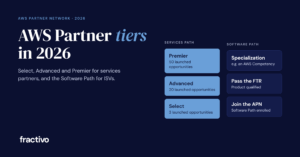
AWS Partner tiers apply to services partners: consultancies, managed service providers and resellers. Specifically, there are three: Select, Advanced and Premier. Each one asks for more certified people and more launched customer opportunities, and Premier adds a set of AWS program designations such as Competencies and the Managed Service Provider (MSP) program.
If you sell software, however, tiers mostly don’t apply to you. Software companies join the AWS Partner Network on the Software Path, where AWS looks at the product itself. AWS qualifies your product through the AWS Foundational Technical Review, and you can add AWS Specializations such as Competencies later.
That split confuses a lot of ISV leaders, because so much partner content talks about tiers as if they were the only ladder. For this reason, this post covers both paths, what each one asks for today, and what changed for 2026.
Services Path tiers: Select, Advanced and Premier
On the Services Path, AWS places partners in a tier based on people, customer results and programs. AWS says you can join the AWS Partner Network at no cost, and the Services Path tiers start at Select. Here is what each tier requires, from AWS’s Services Partner Tiers page:
| Requirement | Select | Advanced | Premier |
|---|---|---|---|
| Annual APN fee | USD 2,500 | USD 2,500 | USD 2,500 |
| Accredited individuals | 4 technical, 2 business | 8 technical, 4 business | 20 technical, 10 business |
| AWS Foundational certifications | 2 | 4 | 10 |
| AWS technical certifications | 2 | 6 (3+ Professional or Specialty) | 25 (10+ Professional or Specialty) |
| Launched customer opportunities | 3, with total MRR of USD 1,500+ | 20, with total MRR of USD 10,000+ | 50, with total MRR of USD 50,000+ |
| Business Partner Package | Not required | Required | Required |
| Competency, MSP or Well-Architected | Not required | Not required | 3, including MSP, DevOps or CloudOps |
| Executive Business Review | Not required | Not required | Required |
| Sustained tier criteria | Not required | Not required | Over 6 months |
A few points in that table matter more than the rest.
Launched opportunities do the sorting
Certifications come from training your team. Launched opportunities, by contrast, are the customer engagements you register in AWS Partner Central and take through to launch, so they depend on winning and delivering customer work. Each tier also sets a minimum monthly recurring revenue across those launches.
Premier is a different commitment
In addition to the larger numbers, Premier asks for three Competency, MSP or Well-Architected designations (including MSP, DevOps or CloudOps), an Executive Business Review, and tier criteria sustained over six months.
The fee stays flat
Every tier pays the same USD 2,500 a year. In other words, the cost of moving up is the people, the certifications and the customer work.
Software companies: the Software Path
An ISV’s standing with AWS rests on its product. On AWS’s Partner Paths page, tiers appear only under the Services Path. Instead, the Software Path asks you to qualify your software through the AWS Foundational Technical Review (FTR).
How a software company joins
AWS’s step-by-step guide for startups lays out the sequence for a software company:
- Join the AWS Partner Network. Registration is free.
- Enroll in the Software Path and confirm your participation. AWS asks you to pay the annual APN membership fee, USD 2,500 as of October 2026, which includes USD 3,500 in AWS Promotional Credits.
- Pass the FTR. Once AWS approves it, your software gets a listing in the AWS Partner Solutions Finder.
- Join ACE, the AWS Customer Engagements program, so you can share opportunities with AWS.
What ISV Accelerate requires
In AWS Partner Central, software partners also carry a status, and the programs that shape co-selling ask for a particular one. For example, the AWS ISV Accelerate program requires Validated or Differentiated status, plus:
- At least one software product listed as generally available in AWS Marketplace
- ACE program eligibility and an Amazon Payee Central account
- At least 5 launched opportunities (ACE or AWS Marketplace private offers) in the past 12 months
- At least 15 qualified ACE opportunities in the past 12 months
- At least one person who has completed the Co-Selling with AWS learning module
- At least USD 2,000 in recognized AWS account revenue at enrollment
Meeting these makes you eligible for the program. From there, AWS describes the next step as building a long-term co-sell strategy with your AWS Partner Development contact. However, AWS still decides how it engages on each opportunity.
As a result, when an ISV leader asks “what tier are we?”, the useful answer is usually a different question: has our software passed the FTR, which Specialization fits our customers, and are we sharing opportunities AWS can act on?
What changed for 2026
Meanwhile, the biggest 2026 changes sit around the tiers, in how AWS reviews Specializations and how it handles the opportunities partners share.
Specialization reviews run through Program Navigator
On October 20, 2026, AWS launched Program Navigator and a Case Study Generator in Partner Central. AWS says specialization applications now get faster reviews with requirement-level feedback. In addition, go-to-market case studies can be published to AWS domains through a lighter policy check.
Validation is moving to an agent
In January 2026, AWS described an automatic validation agent in Partner Central that reviews documentation for the AI Competency and gives real-time feedback, cutting processing time by up to 70%. AWS also said it would extend the agent to more Specializations during 2026.
Every co-sell opportunity now gets a quality score
On June 16, 2026, AWS announced that Partner Central agents evaluate every co-sell opportunity and give it an Opportunity Quality Score, which AWS says “directly influences how AWS engages.” In turn, the score helps place each opportunity in one of three motions: AWS field-engaged, agent-engaged or partner-led. For example, our post The Climb From 50 to 75 walks through what moved one record’s score.
AWS is matching partners to sellers by data
The AWS Solution Matching Engine is a machine learning system AWS introduced in 2025 to help its sellers find relevant partners. In an August 2026 post, AWS said it draws on a partner’s listing details, AWS Specializations and Certifications, and customer engagement signals. We also covered what that means for partners in AWS Is Building the System That Decides Which Partners Sellers See.
Overall, these changes put more weight on what partners record in AWS’s own systems: their opportunities, their listings and their verified capabilities.
Our take for leaders
Everything above is AWS’s own rulebook. In contrast, this section is our view, from working with software companies on their AWS go-to-market.
Know which path you’re on first
Before you plan anything, find your company in this table.
| If you are | Your path | Where to focus |
|---|---|---|
| A consultancy, SI or managed service provider | Services Path, tiered | Certifications, then launched opportunities to reach the next tier |
| A software company selling a product that runs on AWS | Software Path, no tiers | Pass the FTR, list on AWS Marketplace, then pick the Specialization your customers would recognize |
| A software company that also sells professional services | Both | Keep the product work on the Software Path and treat any services tier as a separate goal |
Plan the work in the order buyers and sellers will use it
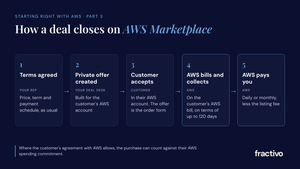
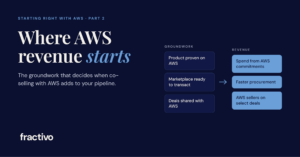
Each step on the Software Path gives someone outside your company something to act on. First, the FTR gets your product listed in the AWS Partner Solutions Finder, where AWS gives Specialization partners priority placement and describes the designation as validating technical excellence. Next, a generally available Marketplace listing lets buyers purchase through AWS, with the charge on their monthly AWS bill like any other Marketplace product. Finally, a Specialization adds a badge enterprise buyers recognize and a verified capability the Solution Matching Engine draws on.
Give AWS’s systems real deals to work with
AWS sellers find partners through tools that read your listing, your verified capabilities and your opportunities. For instance, the ISV Accelerate page cites Canalys research in which 51% of partners report higher average revenue growth from co-selling and 65% say they close deals faster. Because AWS decides how it engages on each deal, the time your team spends documenting each opportunity in Partner Central is time well spent.
Keep services tiers in their own lane
If you also sell professional services, a services tier brings its own certification and staffing costs. In that case, plan it as a separate goal, after the product work that buyers and AWS sellers see first.
If you’re working out which Specialization fits and what it will take, our AWS Competency Readiness and Validation Service covers the readiness review, customer evidence and submission, and you can buy it through AWS Marketplace. For example, the Docebo case study shows how two competency submissions came together in 12 weeks.
FAQ
What are the AWS Partner tiers?
AWS has three Services Partner tiers: Select, Advanced and Premier. They apply to services partners such as consultancies, managed service providers and resellers. Each requires more certified staff and more launched customer opportunities, and Premier also requires three Competency, MSP or Well-Architected designations.
Do software companies (ISVs) have AWS Partner tiers?
AWS lists tiers only for the Services Path. In contrast, software companies enroll in the Software Path, where AWS qualifies the product through the Foundational Technical Review, and programs such as ISV Accelerate look for Validated or Differentiated status in Partner Central.
How much does it cost to join the AWS Partner Network?
AWS says you can join the AWS Partner Network at no cost. Its Services Partner Tiers page lists an annual APN fee of USD 2,500 at every tier, and software companies pay the same USD 2,500 annual fee when they enroll in the Software Path.
How many launched opportunities do you need for each tier?
Select needs 3 launched opportunities with at least USD 1,500 in total monthly recurring revenue. Next, Advanced needs 20 with at least USD 10,000. Finally, Premier needs 50 with at least USD 50,000.
Does reaching a tier mean AWS will co-sell with us?
A tier makes you eligible for more programs and benefits. However, AWS decides how it engages on each opportunity, and since June 2026 the Opportunity Quality Score in Partner Central feeds into that decision.
Sources
- AWS Services Partner Tiers, updated September 25, 2026
- AWS Partner Paths, updated October 15, 2026
- Join the AWS Partner Network: a step-by-step guide for startups, AWS, November 10, 2025
- AWS ISV Accelerate Program, updated October 15, 2026
- AWS Specializations
- Private offers in AWS Marketplace, AWS Marketplace Buyer Guide
- AWS Partner Central agents now accelerate co-selling on every deal, AWS, June 16, 2026
- AWS Partner Central launches Program Navigator, Case Study Generator, and streamlined specialization review, AWS, October 20, 2026
- Solution Matching Engine: Your Gateway to AWS Sellers, AWS Partner Network blog, August 31, 2026