“Be where your customers are.” Every software leader has heard it. Yet most still spend heavily on outbound, BDR teams and account-based campaigns to reach buyers who have stopped answering. Meanwhile, many of those same buyers already hold signed cloud commitments and an approved place to buy software. An AWS Marketplace strategy puts your product where that budget and that buying process already exist.
This post brings together two arguments we’ve made before. First, enterprise buyers have committed cloud budget that needs a home. Second, AWS Marketplace removes much of the friction that slows down software deals. After that, we cover what most software companies get wrong and three questions worth answering this quarter.
Buyers already have budget committed to AWS
Cloud demand is still accelerating. In the first quarter of 2026, AWS segment sales grew 28% year over year to $37.6 billion. Amazon’s CEO, Andy Jassy, called it “our fastest growth in 15 quarters” (Amazon).
A large share of that spend sits under multi-year commitments. Customers sign an AWS private pricing agreement, commit to a minimum spend over a set term, and get better pricing in return. As a result, finance teams track that commitment closely, and any shortfall becomes a real cost.
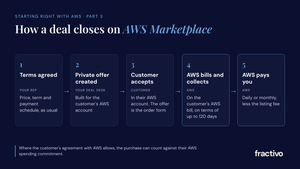
This is where AWS Marketplace comes in. AWS’s private pricing overview states that “qualifying AWS Marketplace purchases all count toward your commitment” (AWS). In other words, a buyer can pay for your software from budget that has already been approved. The key word is “qualifying,” so buyers should confirm with their AWS account team that a specific purchase counts.
Other clouds work in a similar way. For example, Google Cloud announced that from June 9, 2025, qualifying purchases through its Marketplace Channel Private Offers get 100% commit drawdown on the final offer price, up to an allowable 25% cap on the customer’s commitment (Google Cloud).
So if your product isn’t available on the cloud where your customer holds that commitment, you are missing from one of the easiest ways for them to buy.
Why buyers prefer to buy this way
Committed budget is only part of the story. Besides, traditional software buying is slow for everyone involved. Buyers sit through unsolicited outreach, repeated demos and long approvals. Meanwhile, sellers build pipeline only to watch deals stall in security reviews and procurement queues.
AWS Marketplace removes several of those delays:
- Procurement is simpler. The vendor is already set up through AWS, and the charge appears on the AWS bill.
- Discovery is faster. Buyers can compare listings, pricing and terms in one place.
- Review is shorter. Standard contract terms and tools such as Vendor Insights give legal and security teams a head start.
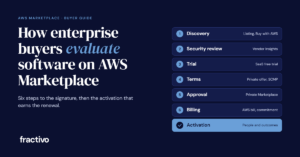
We cover each step in detail in our guide to how enterprise buyers evaluate software on AWS Marketplace.
What the Forrester study found
AWS commissioned Forrester Consulting to study the economic impact of AWS Marketplace on organizations that use it to find, buy and manage software. For a composite organization, the study found (AWS Marketplace blog):
- 377% return on investment, with payback within six months
- 70% less time spent on solution discovery
- 60% faster procurement
- 30% faster time to market
These are buyer-side results. Even so, they explain why so many procurement teams now ask vendors whether they are on AWS Marketplace.
Why your AWS Marketplace strategy can’t wait
Above all, growth at this scale changes how the market behaves. First, customers who signed large commitments need to use them, especially in the later years of a multi-year term, when any shortfall becomes visible. Second, the AI workloads behind much of this growth pull demand into nearby categories. Data tooling, observability, security, governance, deployment automation and vertical applications all sit downstream of AI infrastructure spend.
For that reason, if you sell into one of these categories and your buyer is building on AWS, the window for commitment-funded purchases is open now. By contrast, waiting a year means competing with vendors who are already listed and already known to the buyer’s procurement team.
Where an AWS Marketplace strategy goes wrong
For context, we work with software companies on their AWS go-to-market every week. The same patterns keep surfacing.
Treating the listing as the AWS Marketplace strategy
A listing is a procurement mechanism. The strategy is the motion that brings buyers to it: private offers, a clear plan for which accounts to target, and working relationships with AWS sellers. We often see a company spend six months on a listing, launch it, and then wait for inbound that never arrives. Without the motion around it, a listing produces very little. Our post on getting transactable covers how to build that motion.
Running one playbook across every cloud
AWS, Microsoft and Google each run their own partner programs. In addition, each has different requirements, different ways of working with sellers and different incentives. As a result, a single multi-cloud playbook usually underperforms on all of them. Instead, start with the cloud where your largest customers hold their commitments, then expand.
Assuming AWS sellers will bring you deals
AWS decides which partners its sellers work with and on which opportunities. A listing and a program badge don’t change that on their own. Instead, what helps is making it easy for an AWS seller to see how your product supports their customer’s goals and their AWS commitment. So ask your AWS contacts how Marketplace deals are measured for their teams, rather than guessing.
What a working AWS Marketplace strategy includes
An AWS Marketplace strategy that produces revenue has a few parts that work together. Individually, none of them is complicated. The difficulty is running them at the same time.
A target account list. First, start with customers who already run significant workloads on AWS and buy software through it. Your existing pipeline usually holds more of them than you expect. Your own customers are the first place to look, because a renewal through AWS Marketplace can count toward their commitment if it qualifies.
A private offer process. Most enterprise deals close on negotiated terms. So decide who builds offers, who approves pricing and how fast you can turn one around. A buyer who wants to close before quarter end won’t wait two weeks for paperwork.
Contract terms legal will accept quickly. The Standard Contract for AWS Marketplace gives buyers’ legal teams terms many of them have already reviewed. Therefore, using it as your default can remove weeks from a deal.
A plan for working with AWS sellers. Pick the accounts where an AWS seller has a reason to care about your product. Then give them a short, specific note on the customer outcome and how the purchase fits the customer’s AWS plans.
A way to measure it. Track how many deals close through AWS Marketplace, how long they take compared with direct deals, and how many involve an AWS seller. After two quarters, those numbers show where your AWS Marketplace strategy should invest next.
Three AWS Marketplace strategy questions for this quarter
Before your next pipeline review, answer these with your team:
- Are you transactable on the cloud where your largest customers hold their commitments? If not, you are missing from their easiest buying path.
- Which open opportunities could close as a private offer that counts toward the buyer’s commitment? This is often the fastest way to restart a stalled deal.
- Is your co-sell motion built around what the AWS account team needs for the customer? If it’s built around what suits your team, expect less help.
FAQ
Why should a software company sell through AWS Marketplace?
Because many enterprise buyers already have committed AWS budget and an approved buying process there. AWS says qualifying Marketplace purchases count toward a customer’s commitment, which lets buyers fund your software from budget they’ve already approved.
Do AWS Marketplace purchases count toward an AWS commitment?
AWS says qualifying AWS Marketplace purchases count toward your commitment. Buyers should confirm with their AWS account team that a specific purchase qualifies.
Is listing on AWS Marketplace enough to win deals?
No. A listing makes you easy to buy. However, deals still depend on private offers, a clear account plan and working relationships with AWS sellers, who decide which partners they engage with.
Work with Fractivo
Fractivo helps software companies build an AWS Marketplace strategy that turns committed cloud spend into pipeline, from listings and private offers to working with AWS sellers. If this post raised gaps in your plan, talk to us. We’ll tell you what we see and where we think the leverage is.
Sources
- Amazon.com announces first quarter results, Amazon, April 29, 2026
- Amazon Q1 2026 earnings, About Amazon
- AWS private pricing overview 2026, AWS
- Economic impact of using AWS Marketplace: a commissioned study by Forrester Consulting, AWS Marketplace blog, May 27, 2025
- Upgrades to Google Cloud Marketplace for partners, Google Cloud blog